Telling a yard crane from a container stack in satellite imagery
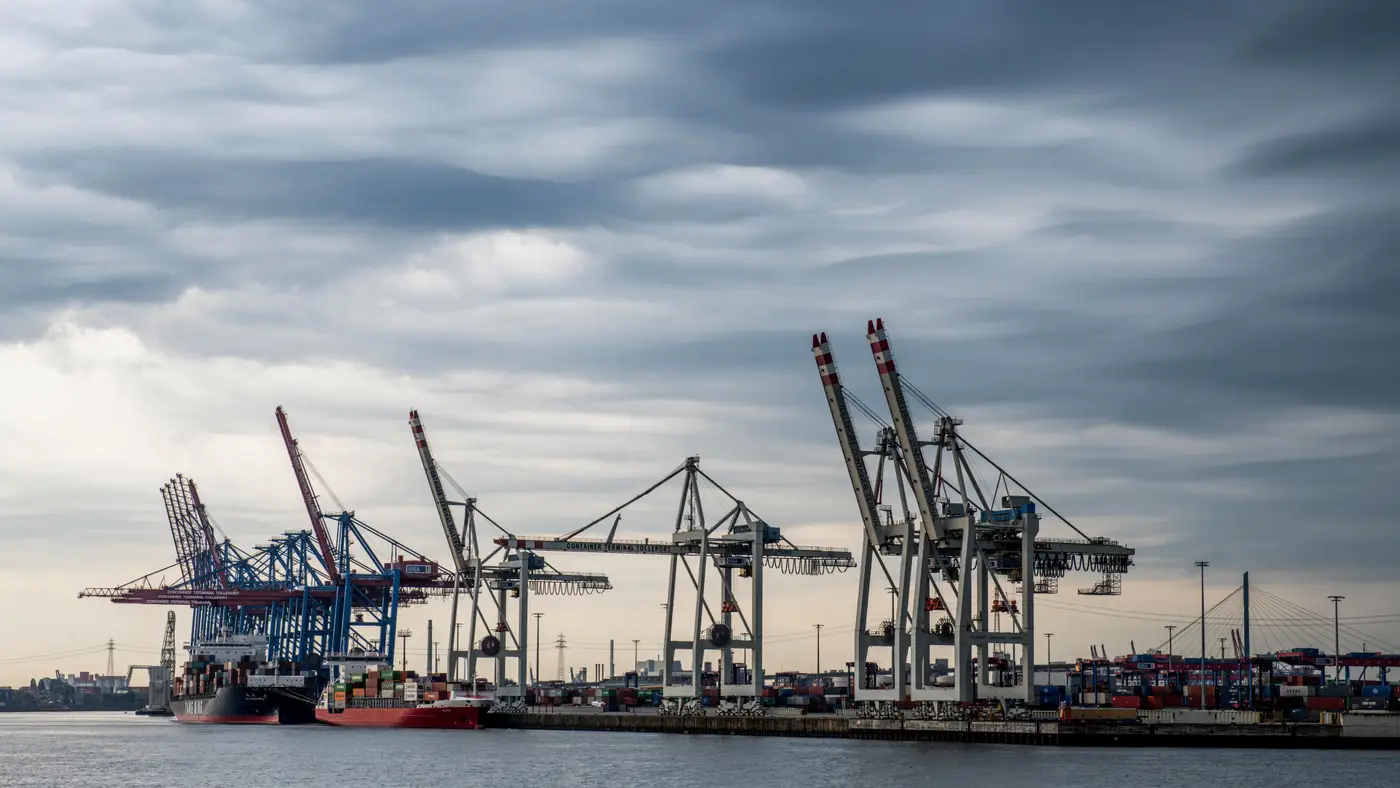
A terminal analyst pulling a box count from a single satellite pass runs into the same problem every time: at typical VHR resolution, a container top and a crane span can look almost identical from directly overhead. Get this wrong across a whole block and the daily count is off by a row or two, which matters for box count accuracy block by block, not just at the terminal total.
Why cranes get counted as boxes
Most VHR programs deliver pansharpened imagery around 30-50cm ground sample distance. A standard 20-foot box runs about 2.4m wide, so it covers five to eight pixels across at best. That resolves a stack's rectangular top well enough, but it's also enough pixels for a crane's rail-mounted span or an RTG's gantry leg to throw off a rectangle of nearly the same footprint, especially at low sun angles when shadows stretch long across the block.
ASC and RTG shadows behave differently, and knowing which is which saves a lot of guessing. An ASC runs on a fixed rail gauge, so its shadow falls as a single straight bar, perpendicular to the rail, length set almost entirely by sun elevation at capture time. An RTG rides on rubber tyres with a wider wheelbase, so its shadow splits into two leg-shadows separated by the span, with the boom's own shadow sometimes crossing into a neighboring bay. If that boom is extended over an active bay at capture time, the shadow can read as an extra row of stacked boxes in a bay that's one row shorter than it looks. That's the usual root cause of a crane boom miscount, whether it's a human analyst drawing boxes by hand or an automated classifier running on a single frame.
Separating stack geometry from crane geometry
A few checks catch it most of the time.
Repetition is the first tell. A genuine stack shows a repeating rectangular top at a consistent tier height across the bay. A crane span is one continuous line, and you can usually see container rows on both sides of it through the gap underneath.
Block alignment is the second. Stacks sit inside the block's bay and row numbering. A crane rail runs along the block's long axis and extends past the block footprint at both ends. Cross-reference against the yard layout and this resolves in seconds.
Day-over-day movement is the most reliable of the three. A crane moves between captures, either driven to the next bay or parked somewhere else on the quay entirely. A stack doesn't move unless it's actually being worked. Any VHR imagery classification error from crane-versus-stack confusion tends to show up the moment you compare today's frame against yesterday's.
That last check is really the whole argument for counting daily rather than off one licensed scene. A single frame forces you to resolve crane from stack on geometry and shadow alone, with no second data point to check your read against. A running sequence lets you resolve it from movement instead, and a block that gained or lost a crane-shaped shadow while its box footprint stayed flat tells you exactly what happened without a site visit. Container Counting runs its block-level counts against that kind of daily sequence rather than a single pass, so a boom shadow over one bay gets caught against the next day's capture before it's baked into the week's number.
If you're trying to get a throughput read that doesn't wait on the port's own monthly statistics, a daily count run block by block is worth a look.